

A Vintage Accord: The New Era of Europe-Australia Trade
News Aggregator/Canberra Report Posted 25 March/Posted on Connoisseur Magazine April 4, 2026
In a move that has sent ripples through the cellars of the Barossa and the creameries of Normandy, the Australia-European Union Free Trade Agreement (A-EU FTA) was officially concluded on March 24, 2026. After eight years of high-stakes negotiations, the “handshake heard ’round the culinary world” promises to reshape the pantries and wine racks of both continents.
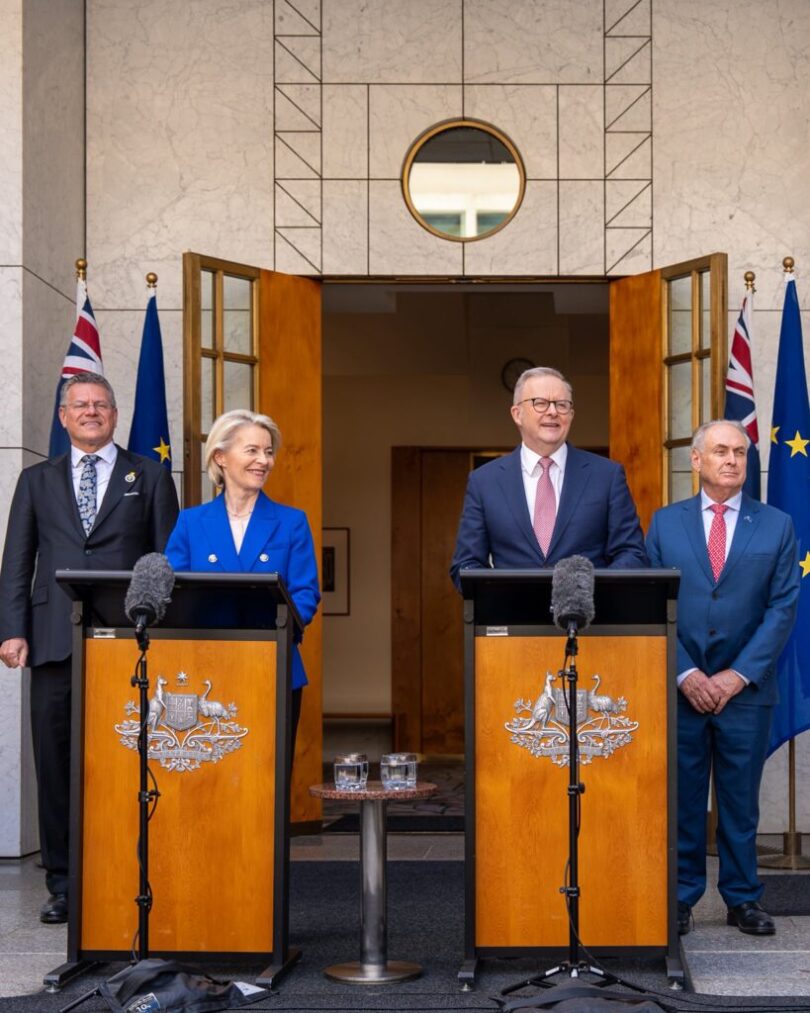
CANBERRA – In a historic breakthrough following eight years of arduous negotiations, Australian Prime Minister Anthony Albanese and European Commission President Ursula von der Leyen have formally concluded the Australia-European Union Free Trade Agreement (A-EU FTA).
The deal, announced on March 24, 2026, during von der Leyen’s state visit to Canberra, marks a strategic pivot for both economies as they seek to insulate themselves from global supply chain volatility and reduce reliance on single-market dependencies.
For the epicurean, this isn’t just a matter of macroeconomics; it is a fundamental shift in how we access, label, and value the world’s finest heritage products.
The Wine Cellar: Duty-Free Flows and the Prosecco Compromise
The headline for oenophiles is clear: zero tariffs on wine and sparkling wine from “Day One” of the agreement’s entry into force. For Australian winemakers, who have faced a challenging decade in global markets, the removal of EU duties provides a vital gateway to over 450 million sophisticated consumers.
However, the deal came with a bittersweet vintage. To secure the agreement, Australia has conceded on the use of the term “Prosecco.”
-
The Transition: Australian producers have a 10-year grace period to continue using the name “Prosecco” for domestic sales and exports.
-
The Future: After this decade, the term will be protected as a strictly Italian Geographical Indication (GI).
-
The Spirit Side: Fans of Greek spirits should note that Ouzo and Tsipouro will be phased out of Australian production over the next seven years.
The Fromagerie and Larder: Protection vs. Access
The most contentious chapter of the negotiations involved Geographical Indications (GIs). Europe has successfully secured protection for 165 agricultural products and 231 spirits in the Australian market.
For the European exporter, the elimination of Australian tariffs on chocolates, biscuits, pasta, and cheeses (phased over three years) means that premium brands like Valrhona or Parmigiano Reggiano will become more competitive at the Melbourne or Sydney checkout.
From Paddock to Plate: A Two-Way Street
The agreement isn’t just about labels; it’s about volume. Australia has secured significantly expanded Tariff Rate Quotas (TRQs) for its premium proteins:
-
Beef: Duty-free access for over 30,000 tonnes of high-quality Australian beef.
-
Sheep Meat: New duty-free access for 25,000 tonnes, allowing Australian lamb to feature more prominently on European menus.
-
Horticulture: Immediate tariff elimination on almonds, macadamias, and walnuts, as well as seafood like prawns and abalone.
What Happens Next?
While the ink on the conclusion is dry, the “Entry into Force” (EIF) typically requires 12 to 24 months of parliamentary ratification. Industry insiders expect the first duty-free shipments to arrive by mid-2027.
For the readers of Connoisseur, this marks the beginning of a golden age of availability. Whether it is the protection of century-old European traditions or the liberation of Australia’s sun-drenched harvests, the table is set for a more integrated—and delicious—future.
A Strategic Alliance Amid Global Turbulence
The agreement arrives at a critical geopolitical juncture. Speaking at a joint press conference, President von der Leyen characterized the pact as more than a mere commercial transaction. “In a world where trade is increasingly used as leverage, this agreement sends a clear signal: friendship and cooperation are the ultimate stabilizers,” she stated.
Prime Minister Albanese echoed this sentiment, describing the deal as a “defining moment” that secures Australia’s role as a “renewable energy superpower” for the European continent.
Key Pillars of the Agreement
| Sector | Impact |
| Critical Minerals | 99% of tariffs removed on lithium, manganese, and cobalt. |
| Industrial Goods | Elimination of 5% tariffs on EU cars, machinery, and chemicals. |
| Agriculture | 98% of Australian exports to enter the EU duty-free. |
| Investment | Preferential access to €845 billion in EU government contracts. |
Agricultural Compromise and “Geographical” Peace
The path to the deal was nearly derailed by disputes over agricultural quotas and “Geographical Indications” (GIs). The final text represents a carefully calibrated compromise:
-
Naming Rights: Australia has agreed to protect 165 European food GIs and 231 spirit GIs. Names like Pecorino Romano and Ouzo will be phased out for Australian-made products.
-
The “Feta” Grandfathering: In a win for local producers, Australian dairy farmers who have used terms like Feta or Gruyère for more than five years can continue to do so, provided the origin is clearly labeled.
-
Beef and Sheep: While the EU opened two new tariff-rate quotas (30,600 tonnes for beef and 25,000 tonnes for sheep meat), the National Farmers’ Federation (NFF) expressed “extreme disappointment,” arguing the access remains too restrictive compared to deals the EU has signed with other regions.
Looking Ahead
The agreement now moves to domestic parliamentary processes in both Canberra and Brussels for formal ratification. Beyond trade, the leaders also signed a new Security and Defence Partnership, aimed at increasing cooperation on cyber security and maritime safety in the Indo-Pacific.
With the global economy navigating “choppy trade waters,” as Australian Trade Minister Don Farrell put it, this deal provides a much-needed anchor for two of the world’s most like-minded partners.